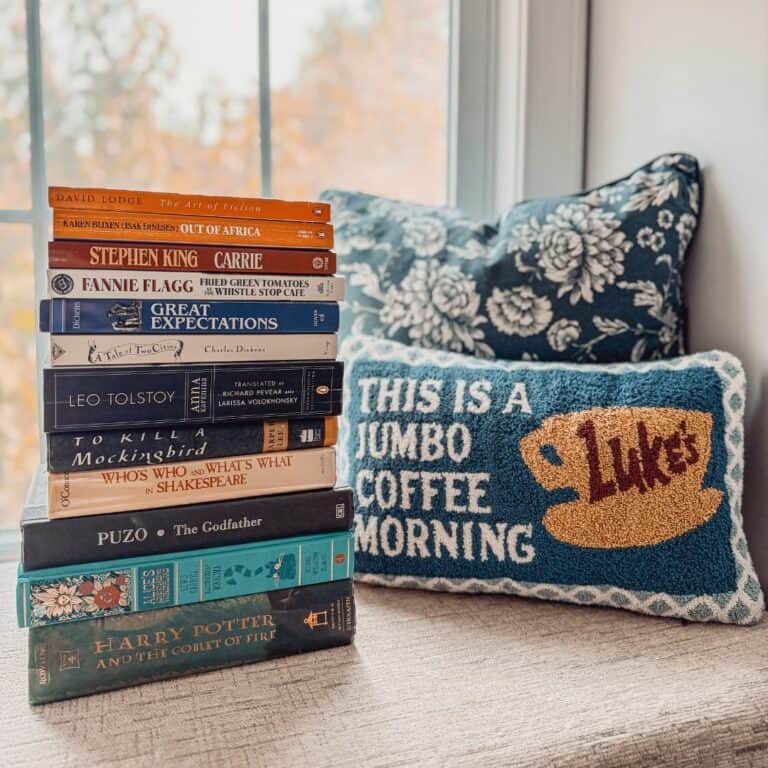

Recap of Season 1, Episode 14: “That Damn Donna Reed”
In “That Damn Donna Reed,” Lorelai convinces Luke to repaint the Diner with her help. Lorelai, Rory, and Dean watch The Donna Reed Show, which causes tension with Dean, who likes the traditional wife aesthetic Lorelai and Rory mock. While watching Babette’s and Morey’s new kitten, Rory cosplays as Donna Reed and cooks for Dean, while they discuss the issue further. Meanwhile, Luke helps Lorelai find the escaped baby chick Rory is watching for school in their home.
The episode begins with Lorelai, Rory, and Dean watching The Donna Reed Show, which Dean never heard of, and boy, does this episode give us a lot to unpack.
I’m not a traditional (“trad”) wives expert, but I’m going to do my best to tease it apart for you because I think it’s worth our time. That said, this is a really controversial episode of a very escapist show, and this is not meant to be a political podcast. My goal is to be open and respectful, and simply foster thought on a super complex issue that doesn’t have easy answers.
I spent more time on this episode than on any other because I value unique perspectives and experiences, and I want you to feel respected as a listener with your own point of view. I hope it shows.
But while I try to keep an open mind, I do take one clear stance. In the hours and hours I spent poring over this episode, which continually forces us to question reality and illusion, my biggest takeaway is that I fear that women never win. I think this is so telling about our history and how far we have to go.
Let’s dive in. Here’s how it all starts.
Dean: “So, who’s Donna Reed?”
Lorelai: “You don’t know who Donna Reed is? The quintessential ’50s mom with the perfect ’50s family?”
Rory: “Never without a smile and high heels?”
Lorelai: “Hair, that if you hit it with a hammer, would crack?”
Lorelai and Rory proceed to inform him, famously, that “It’s a lifestyle. It’s a religion.” Ironically, Gilmore Girls has come to be known as such. Or, maybe it’s not so ironic. After all, Lorelai and Rory follow up by explaining to Dean that they love the show because “nothing happens.”

I think that what they really mean is that nothing bad happens. It’s the comforting feeling of idealism that keeps fans of both shows coming back for more.
But, then, as Lorelai gives him a side eye with more disdain than my hungry cat, Dean responds,
“I don’t know, it all seems kind of nice to me… families hanging together, I mean, a wife cooking dinner for her husband. And look, she looks really happy. What if she likes making donuts and dinner for her family and keeping things nice for them and…I feel very unpopular right now.”
This is where things get interesting. Look, I know many think of Dean as the bad guy for this way of thinking, but personally, I’d rather explore both sides like the lawyer I once was. I told you I want to approach this episode with an open mind!
First, let’s take Dean’s side. What’s so wrong about families hanging out together? Isn’t that the definition of a good upbringing? And why shame a woman for supporting her family, especially if she’s happy?
Next, round two, by Lorelai and Rory. Lorelai thinks Donna Reed must be on medication, and Rory says she’s acting. The key to their argument is that they don’t believe she’s actually happy; they believe she’s succumbing to societal pressure and not being authentic.
This brings up a lot of interesting fodder in today’s age of “trad wife” influencers. Social media users now crave the same idealistic feelings of Donna Reed that modern trad wives bring. In a world on fire, it just feels nice to feel the safety of a peaceful home and the warmth of fresh bread coming out of the oven. It’s aspirational in a way that feels achievable.
But, to Rory’s point, like Donna Reed, many trad wives are acting. Their homes are actual sets with film crews and shooting days. They have nannies and are actually running six to seven-figure businesses in addition to homemaking.
So, there can be a duality in what they post. They argue for the benefits of only homemaking, but they homemake for a paid living themselves. This can beg questions.
And this is the point in the show when I first reached the conclusion I mentioned earlier. What’s interesting to me about the many sides of this argument, and people’s many unique backgrounds and beliefs, is that it’s seemingly always a losing battle for women:
- If a woman chooses to be a homemaker and is happy, many people don’t believe her, and others shame her for not finding fulfillment outside the home.
- If she chooses to be a homemaker and isn’t happy, well, she isn’t happy.
- If she chooses to work outside the home and is happy, many people shame her, and she’s also probably pretty spread razor-thin in her so-called “work-life balance,” which is pretty non-existent these days.
- If she chooses to work outside the home and isn’t happy, then, again, she isn’t happy.
The scene more or less ends there, so let’s move on from this discussion–for now, at least.
Rory worries about a ping or a dink in her brain, but Lorelai solves it by telling her she’s reading too much. Is there ever such a thing?
At Luke’s, Lorelai tries to convince him to paint by offering to help. She’s got a song and all, and this is one of those lines from the entire series that I can hear in my head:
Lorelai: “Grab your brush and grab your rollers, all you kids and all you… bowlers. We’re going painting today!”
At Friday night dinner, Emily and Richard reveal that they aren’t going to Martha’s Vineyard this year because they waited too long to book their rental. Though Emily thought they should have bought a home years ago!
When it comes to Martha’s Vineyard, I’ve got a lot to say! My husband’s family started going there each summer right around the time this episode aired, and I started joining them in 2015. It’s my happy place, and I got engaged on the beach there in 2018.
It’s off the coast of Massachusetts, and I love that Richard and Emily chose this over its sister island, Nantucket, which is more pretentious, in my humble opinion. I’ve also been to the continental shores of Cape Cod, but I prefer it less than both islands because it doesn’t feel as escapist. You still have to sit through a lot of traffic and drive on highways to get around, which makes me feel like I’m back in Philly.
Martha’s Vineyard, for better or worse, doesn’t even have one stoplight! It’s actually pretty large (about 2 hours of driving around the perimeter). It offers a collection of unique towns with specialties ranging from farming and fishing to luxury shopping, Victorian charm, and sailing.
It’s generally more diverse and liberal than Nantucket, which gives the vibe of uber wealth. Think of it this way: entering Martha’s Vineyard, you see a lot of sailboats. Entering Nantucket, you see a lot of yachts.
Probably my favorite thing about it is the mild summer weather of New England. I am the kind of person who’s happier in a sweatshirt and doesn’t care for sunbathing. This is why I find Emily’s and Richard’s timing to be a bit of a goof in this episode, which would have taken place in late winter/early spring.
Not only would it be dark and frigid there during spring break, but many establishments, such as shops and restaurants, wouldn’t even be open until summer. Off-season, it’s mostly just islanders there: sailors, fishermen, farmers, etc.
The whole booking a rental thing also cracked me up because my in-laws usually book the next year’s trip there as soon as we get home. It’s that in demand, especially when you have the needs of a group. There are many zoning rules, including a lack of “chain” businesses (restaurants, hotels, even pharmacies) and preserved land, so hospitality is limited.
While Emily would probably be “right” about purchasing there from a financial standpoint, as property values have risen substantially since the Obamas made it their summer vacation spot during Barack’s presidency, I’ve always thought owning there would be a big challenge. The weather and the water are unforgiving in the off-season, especially, and the island can also be hard to get to.
Before Philly started doing direct flights during the summer, we used to drive to Rhode Island from about 3 p.m. to 11 p.m., stay overnight, and then take a two-hour ferry the next morning, all so we didn’t miss the ferry, which can also be a hassle to book, especially if you are taking a car with you. What I’m trying to say is that it would be tough to manage winter problems from afar.
Anyway, Richard and Emily also can’t go to Europe either because it’s “not in the budget,” but I think that is a flub, too. When has anything ever not been in their budget? Exactly what kind of budget are they talking about? I don’t doubt that Paris in the springtime is a fortune– I know, I’ve looked. But I also think there has to be a realistic travel solution here.
Anyway, Babette stops over to Lorelai’s and Rory’s seeking a sitter for her new “baby”–a kitten named Apricot (after the passing of Cinnamon in Cinnamon’s Wake). As a cat mom myself, I love how she calls Apricot her baby. I also love how Lorelai doesn’t shame her for this. I especially love it in the context of this episode, as we continue to explore the meaning of 21st-century femininity.
Babette offers Rory the chance to watch Sex and the City —another early 2000s beacon of female empowerment, but we’ll get to that later.
Rory brings a baby chick home from school and seeks Dean’s company at Babette’s, but he’s too busy at the store, you know, selling all that food to repressed housewives. Rory calls him out on his passive aggressiveness.
Dean concedes that The Donna Reed Show is “a little over the top,” but here’s Rory’s problem:
Rory: “It’s the having to have the dinner on the table as soon as the husband gets home, and having to look perfect to do housework, and the whole concept that her one point in life is to serve somebody else.”
Rory’s not wrong —women deserve so much more than history has given us, and we know from her upbringing, her reading list, and her aspirations that she cares deeply about this. Her idol is Christiane Amanpour, after all!
But then, Dean says Rory only feels that way because her mother feels that way, and this is an interesting comeback. Rory’s whole argument centers on female independence, and he’s saying she’s no more independent in her thinking than Donna Reed was. Ouch!
At the same time, though, Dean’s perspective is based on his upbringing. See how much of a Catch-22 the whole “trad wives” argument can be?! (Yes, a book reference!) To me, the problem, as I alluded to earlier, lies in my fear that women never win.
Dean reminds Rory that Donna Reed isn’t real, but she is. I mean, it’s called The Donna Reed Show. I guess he’s referring to the character of Donna Stone.
Meanwhile, Lorelai works on paint colors for Luke’s, and I’ve got to say how especially cozy Luke’s looks at night. It must be the mini lamps at each table. We learn the history of Luke’s and his dad’s hardware store, which Lorelai finds heartwarming.
At Babette’s, Apricot is so adorably precious! Too bad Rory up and leaves to borrow music from Lane!
Lorelai loses Stella, the baby chick, and screams! Naturally, she turns to Luke. As an Enneagram 6, a personality type known as a “loyalist,” I can confirm that Luke’s true nature as one himself is coming through very clearly right now as he heads over to help.
We have our faults, anxiety being one of them, but on the plus side, it’s almost as if being there for people is our love language. That is, even if he did, somewhere in the back of his mind, think that it was perhaps code for “not wearing any underwear,” as Sookie later says.
Next, the episode reaches its climax when Dean pops over, and Rory answers the door dressed as Donna Reed, offering a good old-fashioned, “Honey, you’re home!” This was a classic old sitcom line, so it’s very fitting.
While many may cringe at Rory, I don’t fault her in this controversial moment in the series. She is young, in love, and just had her beliefs challenged for, maybe, the first time. She’s exploring how she feels about an opposing view, and she’s considering more deeply the compromises and grey areas that come with being in a partnership, albeit in costume.
For example, what if a woman chooses to be a homemaker because she earns less than the cost of daycare? And, on the other hand, what if a woman works outside the home because she feels pressured to do so?
Then, no matter the circumstances, as we discussed, happiness is a spectrum, and shame is abundant, no matter how you slice it for women.
Anyway, the writing really is something, here, as Dean compliments the circumference of her dress. Take that for what you will.
As it turns out, Rory made Dean dinner: appetizers, steak, green beans, mashed potatoes, and dessert (lime fantasy supreme). She’s proud of herself– but only until she realizes she forgot to make the rolls, and deems her dinner a failure.
This scene displays her original argument—that homespun perfection is an illusion—but it also shows how women feel shame for failing to achieve it. Again, I come back to my conclusion that women are never the winners here.
Dean kisses her in return, and while I’ve tried to be kind and open to him this entire episode, this does creep me out a bit. He wanted his non-trad wife to be a trad wife. She gave in, and he kissed her for it. Luckily, he redeems himself:
Dean: “As amazing as this whole thing was, I mean, the music, the outfit, the dinner, I hope you know that I don’t expect you to be Donna Reed. And I don’t want you to be Donna Reed. That’s not what I meant. This just totally got blown out of proportion. I’m actually pretty happy with you.”
Rory: “I know, and I appreciate that, but aside from this actually being fun, I did a little research on Donna Reed.”
Dean: “You did research on Donna Reed?”
Rory: “Look. See, she did do the whole milk and cookies wholesome big skirt thing, but aside from that, she was an uncredited producer and director on her television show, which made her one of the first women television executives. Which is actually pretty impressive.”
Now, while I am happy with Dean in this moment, in challenging his belief system the way Rory did, this is what gets me about Rory’s reasoning. She’s impressed by Donna Reed’s achievements, and they were, indeed, achievements, but by Rory’s own words, Donna Reed was an oxymoron–“an uncredited producer.” Is this so-called job title feminist or anti-feminist? Should we be happy that she was a producer or mad that she was uncredited on a show with her own name as its title, nonetheless?
I’ve said it before, and I’ll say it again: my takeaway from the controversial arguments in this episode is I fear that women never win.
Dean and Luke both take out the trash, and I find that interesting as well. It seems to be asking whether the Gilmores want to challenge women’s stereotypes but not men’s, and whether that’s okay.
I’m actually not mad about this pro-male moment in a pretty feminist show. I think the act of questioning this forces us to consider that real life is nuanced and complicated, and, really, the best we can all have is true free will in our own homes, free from pressure, shame, or unhappiness —man or woman. And a society that supports the same!
Back to the episode! Dean and Rory catch Luke and Lorelai, and visa versa. This was a very heavy episode thematically, and this moment of both mother and daughter being caught doing something weird with a boy at the same time was some much-needed comic relief.
I also have to note the irony that both Lorelai and Rory lose an animal in this episode. The writers really want us to know that caring for something living, other than ourselves, is challenging.
Finally, we get to see Michel and Sookie at the Inn. Sookie questions Lorelai about inviting Luke over, and, really, this scene continues to set up the question of “Will they or won’t they?”
At Friday night dinner, Richard and Emily finally find a place on Martha’s Vineyard, even though it’s practically uninhabitable in early spring, and Emily has a quip that I wouldn’t necessarily call a “savage burn,” but is sharply comedic:
Emily: “Be careful, Richard. That canary you ate is going to swallow your dinner.”
Finally, Lorelai admits to her mother that she may have feelings for Luke. This is really big!
She and Luke make plans to paint on Friday, but just as it seems all will end well in Stars Hollow after a very complex episode, Christopher pulls up on a motorcycle.
Rory hops on, and I can’t help but think of Lorelai’s famous line from the Pilot: “If you’re going to throw your life away for a man, he better have a motorcycle.” The writing on this show is just so smart.
What a cliffhanger!
But, before we move on, I want to say thanks for sticking with me on this one. I know it’s a controversial episode, and I hope I showed respect for your unique perspective while also encouraging you to think deeply and with empathy.
Books and Authors Referenced
Let’s break down the Gilmores’ world of books– this episode’s most iconic literary references for those taking the Rory Gilmore Reading Challenge with us on Fridaynightreaders.substack.com, where we read from the list of books mentioned on Gilmore Girls.
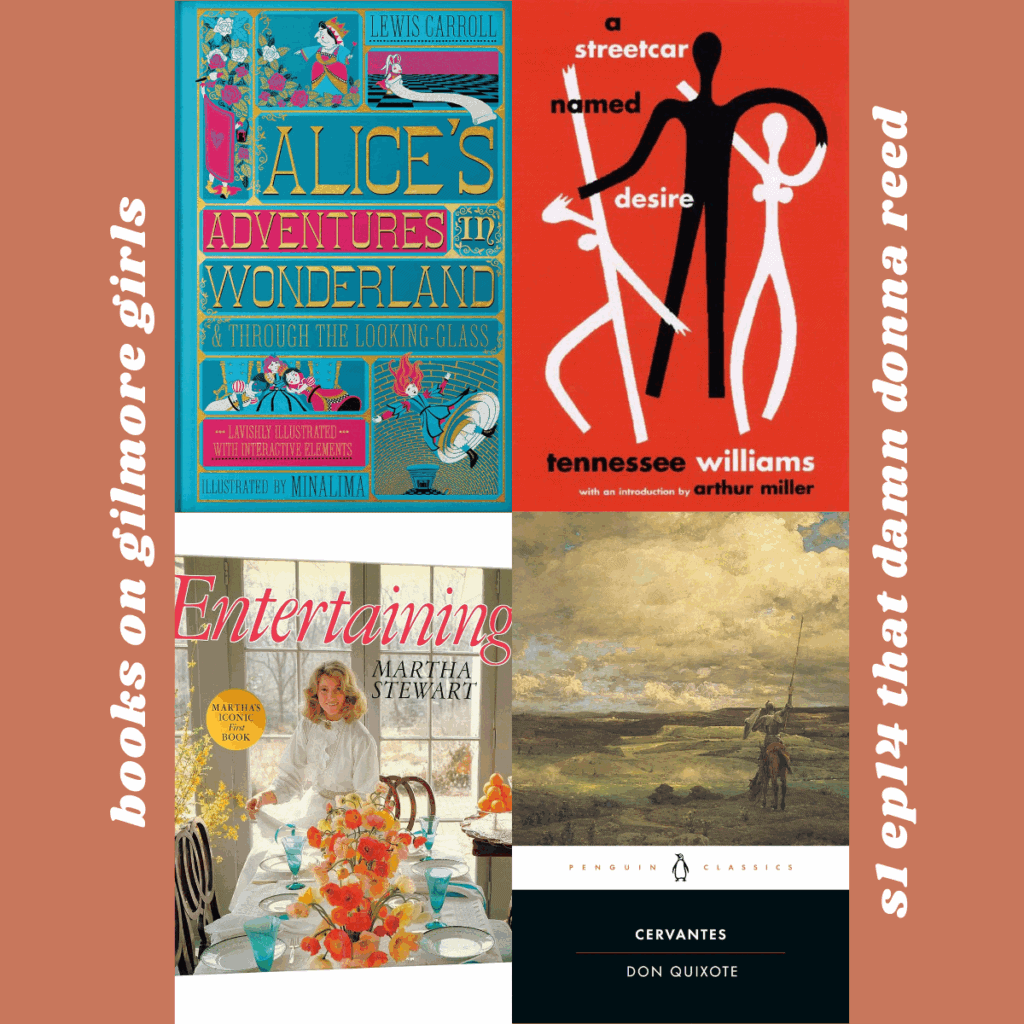
- Lewis Carroll
- A Streetcar Named Desire by Tennessee Williams
- Martha Stewart
- Miguel de Cervantes
First, Lorelai refers to Lewis Carroll, who wrote Alice in Wonderland, when Emily talks in circles about Europe in the fall and the spring. This is one of the show’s most popular book references, which we’ll hear again and again, so I won’t go into too much detail here.
For now, I’ll just offer a quick reading tip. The fantastical elements of the plot make it a good candidate for an illustrated edition. I have MinaLima’s, which is both illustrated and interactive.
Next, Luke refers to Martha Stewart, author of several lifestyle books, magazines, and cookbooks. While she’s also a TV host and so much more, her books catapulted her to fame, so I’m taking a look at her influence in the context of books here.
I’m a longtime fan of Martha Stewart, and the intention behind her reference here isn’t lost on me: She’s, in some ways, a modern Donna Reed. Her lifestyle creations and curations are perfectly crafted, and she’s an astute businesswoman, yet we also know there’s a dark side.
For one, she was imprisoned for insider trading. She was also deemed difficult to work with (as perfectionists are) and struggled with work-life balance as a mostly single mom.
Her recent Netflix documentary was so good, I watched it twice. I also just purchased a reprint of her first book, Entertaining, which I plan to peruse over the upcoming Christmas holiday. I have to admit that, as we navigate the complex issues of femininity in this episode, I do find irony in my returning to an aspirational lifestyle as an escape from the real world. To me, this just goes to show how nuanced it all is.
Next, Lorelai names the baby chick Stanley, then Stella, both after characters in A Streetcar Named Desire by Tennessee Williams.
Lorelai: “Alright, I’ll name him. Hi! Your name is Stanley. Hi, Stanley.”
Rory: “It’s a girl.”
Lorelai: “Oh. Sorry about the Stanley thing. Your name is Stella. Stella’s nice, and Stella was married to Stanley.”
This is a popular 1947 play about illusion and reality– so this is another really smart reference for this episode. These writers really want us to think!
It follows Blanche DuBois, a fragile Southern woman who moves in with her sister Stella and Stella’s husband, Stanley Kowalski, in New Orleans. Blanche lives in fantasy and nostalgia, while Stanley is blunt, aggressive, and obsessed with the truth. Their conflict slowly destroys Blanche.
I read this play in high school and remember our class really liking it. It felt tense and passionate, as if New Orleans were the perfect setting for the simmering heat rising to the surface.
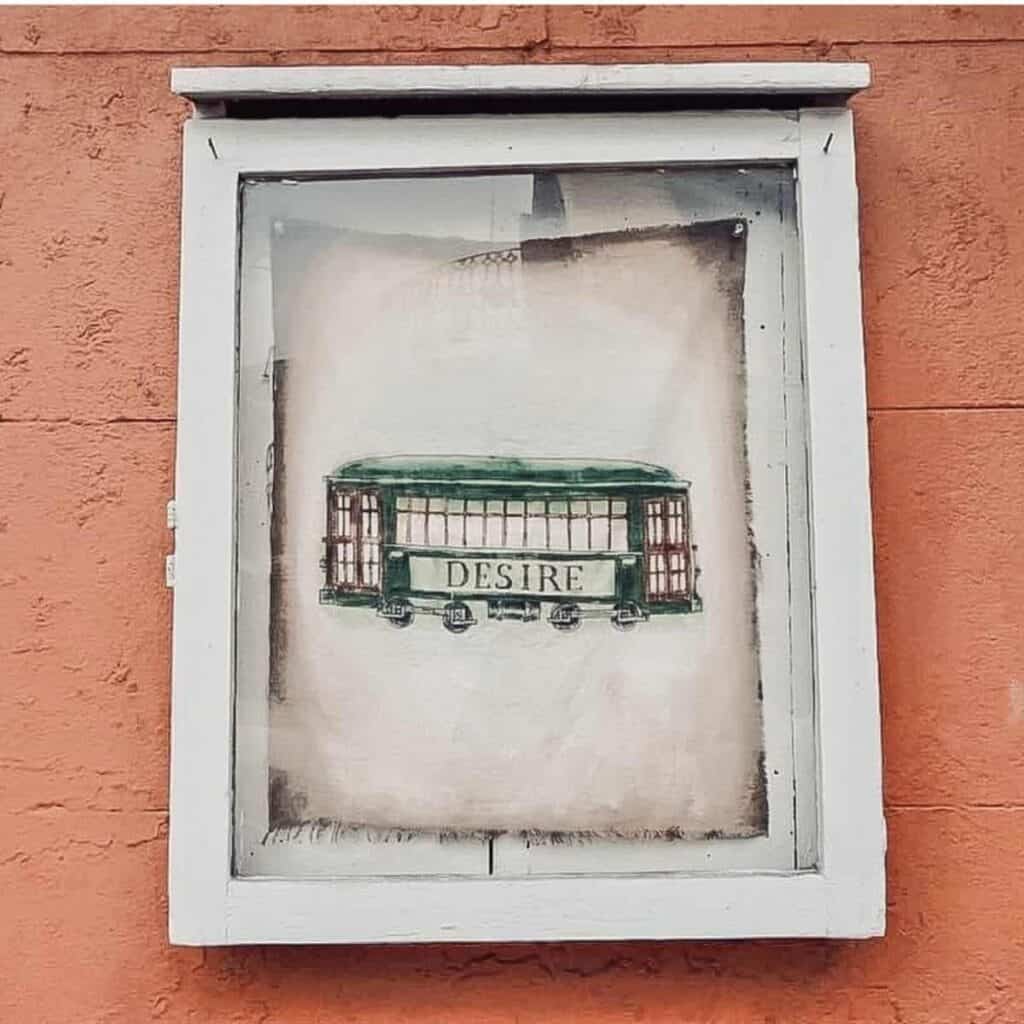
My husband went to college in New Orleans, so we do go back and visit, and I once spotted a picture of a streetcar named, you guessed it, Desire, in the French Quarter.
I also want to note that in New Orleans, the beautiful and historic Hotel Monteleone inspired many great visiting writers, whose names are immortalized in literary suites where guests can stay, including one dedicated to Tennessee Williams. If you go, you’ve got to visit the hotel lobby’s Carousel Bar, which slowly rotates as you sip your cocktail, and hosted Williams.
In fact, the city is brimming with Williams’s influence. Tennessee Williams wrote A Streetcar Named Desire at the Pontchartrain Hotel. A reproduction of a page is in the lobby. The Louis Adam House was Tennessee Williams’s first home in New Orleans. The author also bought a townhouse at 1014 Dumaine Street and lived there on and off from 1972 until his death in 1983.
Further, one of the oldest bars in the United States, Lafitte’s Blacksmith Shop was one of Tennessee Williams’s favorite bars. Our New Orleanian friends told us it’s a cool place to grab a drink. Also, be sure to dine at the French Creole restaurant Galatoire’s, which was Williams’s favorite restaurant and a place visited by Stella and Blanche in his play A Streetcar Named Desire.
How do I know all of this? Well, one of my favorite things to do is travel research, particularly of the literary sort. I’m the kind of person who leaves no stone unturned when planning travel.
Finally, Richard tells Rory he’ll get her a nice edition of Cervantes, who wrote Don Quixote, a 17th-century classic (one of the first novels) about an old man who reads so many chivalric romances that he decides to become a knight.
He sets out to fight evil, and sees the world through fantasy (most famously mistaking windmills for giants) while his practical sidekick Sancho Panza tries (and fails) to keep him grounded.
Guess what? It’s also often seen as a story about the power of imagination versus reality. As much as I don’t want to be a controversial podcaster, it’s hard to escape here. The writers are just begging us to think deeply.
Anyway, I haven’t read Don Quixote because it’s very long and, thus, scary. But, its dark humor does intrigue me. Wouldn’t this make for a great modern adaptation?!
A few related book recommendations before we move on. First, I recently read a popcorn thriller about the illusory facade of trad wife influencers, Everyone Is Lying to You by Jo Piazza, and interviewed her about it directly in the context of this episode.
It’s a book I’m still thinking about months later, and given her research, she’s an expert on this complex, controversial topic, with so many eye-opening insights, some of which are similar and some unique to mine. This is a great place to continue your journey into the topic of illusion versus reality in feminism.
Second, as a longtime visitor to Martha’s Vineyard and avid reader of books set there, I maintain an updated list of my favorite books set in Martha’s Vineyard. I’ve pretty much read them all at this point, so I think it’s now a really top notch curation to check out!
Curious about every single book mentioned in this Gilmore Girls episode—even the obscure references most people miss? Head to this episode’s page at Fridaynightreaders.substack.com. Paid members get printable episode guides for every Gilmore Girls episode, which are perfect for tracking your own Rory-inspired reading journey.
Up Next
Lastly, the time has come for me to be what Jess called Rory—a book tease. Tune in next week, when we dive into episode 1.15, “Christopher Returns,” and books like the Compact Oxford English Dictionary, of course!